


Unsightly, constantly peeling, yellow nails are the main sign of a fungal infection.Most often, this problem worries us in the summer, when we wear open shoes, visit beaches and other habitats of pathogens.From this review, you will learn what nail fungus is, why it is dangerous and what treatment it requires.In addition to pharmaceutical drugs, there are many effective folk remedies that you can use independently or as recommended by a specialist.
What is nail fungus?
Nail fungus or onychomycosis is one of the most common fungal diseases.You can get infected with it in the sauna, swimming pool, on the beach or at home.Example - if someone in your family had onychomycosis, was treated and recovered, parasite spores can live for a long time in the bathroom, on the tiles in the kitchen and hallway, on carpets and house slippers.People with soft nail plates are most susceptible to the disease, but strong nails alone do not ensure infection with dermatophytes.
Factors causing the development of onychomycosis:
- poor quality, too tight shoes (especially from unnatural materials);
- trauma, plate deformations;
- nail extensions;
- lack of personal hygiene;
- use of certain household chemicals.
The risk of developing onychomycosis increases with age, because metabolic processes slow down over time, and the nail tissue recovers much more poorly.Children usually get infected from adults.
Symptoms of the disease
The main symptom with which patients come to the doctor is a change in the thickness and appearance of the nail plate.It becomes thin, yellowish or black, breaks, crumbles.A characteristic unpleasant odor often occurs.If nothing is done, the parasites will spread to the entire foot, resulting in roughness, severe itching and pain when walking.
Types of fungi and characteristic symptoms
- moldy– given
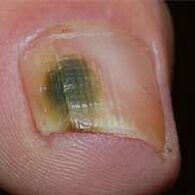 The pathogen "loves" an organism weakened by long-term illnesses.This causes the nail plate to change color to green, yellow, blue or black.
 - Dermatophytes- on the nails
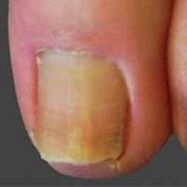 Yellow streaks and spots appear, the yellowed edges move away a little.As the pathology progresses, the yellowness moves to the middle of the plate.
 - Yeast- nail biting
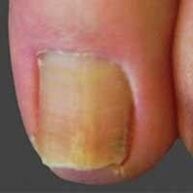 uneven, wavy, covered with grooves.The shade changes to yellow and brown, most often the nail plate is completely removed.The rollers can be fertilized.
Keep in mind that fungi colonize living tissue very aggressively.They are dangerous not only for their owner, but also for other people, so do not waste time - start treatment as soon as possible.Fungal infection is practically not complicated by secondary bacterial infection.
First aid
The first thing you should do when you notice symptoms of onychomycosis is to improve your diet and treat your shoes.
Diet
The diet should be complete and balanced, to support a healthy microflora (and not one that will be favorable for the growth of fungi).It should be monitored from one to six months, depending on the stage and severity of the disease.You will have to completely give up alcohol - alcohol worsens blood circulation and reduces local immunity.
The fungal pathogen likes:fiber, starch, sugar, sweets, dried fruit, packaged juices, fermented milk with berries and sugars (mainly yogurts), canned food, sausages, semi-finished products.
You can eat:
- fresh herbs, vegetables (except potatoes and other starches);
- vegetable juices;
- herbal teas, rosehip decoction;
- cereals (except rice, semolina);
- vegetable oils;
- soybeans;
- nuts, seeds.
Such a diet prevents intoxication of the body and accelerates the healing process.The downside of a diet is that you have to stick to it all the time.
How to treat shoes against nail fungus
Be sure to treat your shoes against fungus.First, wash thoroughly with soap and dry.Remove the laces and insoles and wash them separately.You can then apply disinfectants;if you are afraid of spoiling the material, you can test its effect on a small area.When working with toxic chemicals, it is recommended to use a cloth mask and protective gloves.
With the help of folk remedies, the shoes are treated from the outside and inside, then cotton wool or fabric soaked in the solution is placed in the toes, wrapped in a bag and left for several days.The effectiveness of ammonia, vinegar and formaldehyde is high, but they have a specific smell and can spoil some materials.Special sprays are more expensive, but they work more delicately.You have to spray them on the inner surface and leave it for a day.To achieve maximum results, the treatments are carried out 5 times in a row.Chlorhexidine can be used.
Other methods are antibacterial wipes and an ultrasound machine.The first option is easy to use, but has average efficiency, the second is powerful, safe, but has a high price.It is enough to treat the shoes with ultraviolet light for 3-10 hours, depending on the model (see instructions).
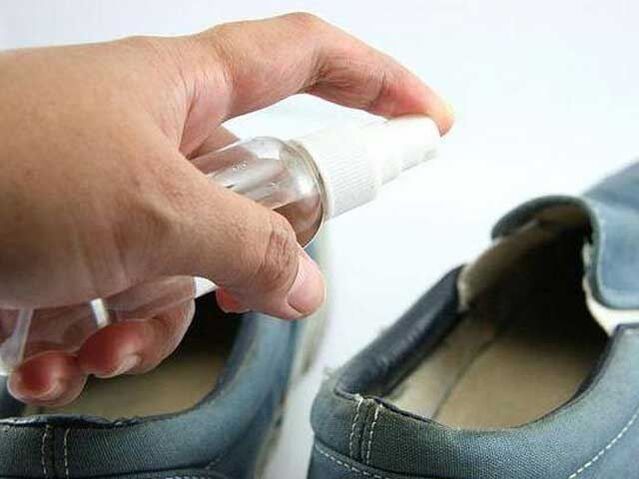
We have collected the most effective folk remedies for the treatment of fungus
Popular folk recipes for mushrooms:
- Essential oils– lavender, mint, citrus, eucalyptus.It is recommended to mix lavender with tea tree - in this case you will get an effective antimicrobial agent with an antibiotic.The most important thing is to use natural ingredients, because artificial ones, although they smell delicious, do not bring any health benefits.Therefore, buy in pharmacies and authorized outlets.Apply the oils once a day, preferably before going to bed.
- Kombucha- attach the mushroom plate to the painful nail overnight, wrap it in foil or a bag, wrap or put on a sock.In the morning, remove the dressing and apply iodine to the nail.After a few treatments, a healthy nail should begin to grow, but it is best to continue treatment until complete recovery.
- Propolisit contains the medicinal secretion of the salivary glands of bees, microelements, vitamins, tannins and has a pronounced pleasant aroma.For the treatment of fungi, it is used in the form of ointments and tinctures.Cool the propolis, chop it and add vegetable oil heated to 50-60 degrees, mix for 10 minutes, cool and strain.
Store the finished fat in a glass container, always in the refrigerator.Apply at night, cover with gauze and secure with a bandage or sock.The tincture is applied directly to the nails.You can use a ready-made pharmacy or make it yourself.
- St. John's wort– rub painful nails with plant juice twice a day.You can supplement the treatment with baths with decoction or infusion.Celandine is used in a similar way.
- Ginger– it is used in grated form, like juice, in slices.The application should be done at intervals of 10 minutes, do not rinse anything with water.
- Iodine- smear your nails with iodine tincture in the morning and in the evening every day.The course of treatment is 3 weeks.
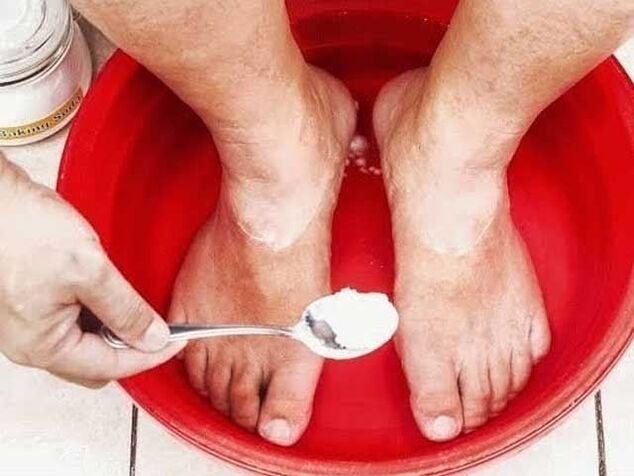
- Sodait is used in the form of baths.Dissolve 5 g of soda and 3 g of common salt in warm water, mix and bathe every day for 20 minutes.Baking soda and water can be used to make a paste that is then applied to the nails.
- Garlic- soak a small clove in salt and apply to the affected area.For greater efficiency, the garlic is pre-minced.
- Hydrogen peroxide– first steam your feet in a bath of baking soda, then soak a cotton swab in peroxide and apply to the affected area.To prevent the compress from evaporating, wrap it in foil.You have to keep the product for an hour.The course of treatment lasts several weeks - feel free to use this recipe until you fully recover.
- Ammonia– add a spoonful of ammonia to a cup of water.Soak a piece of cloth in the liquid and apply the compresses.It is best to keep this medicine overnight.
- A bow- grate on a fine grater, apply the resulting slurry to the affected areas.Onions are used as a poultice.
- Alcoholeffective in the initial stages of fungal development between the fingers and on the nails.Soak a cotton swab in the product and apply it to the affected areas.In advanced situations, alcohol does not help.
- Boric acid– steam and then dry your feet well.Take the powder and sprinkle it on the problem areas, put on socks and leave it overnight.The procedure can be repeated daily.
- Washing powder- also an effective remedy for onychomycosis, whose principle of action is an alkaline reaction.Dissolve the powder in hot water and steam your feet in the tub.A two-week course is usually required for full recovery.
- With potassium permanganatetake baths for 15-20 minutes, it is necessary to repeat them daily.After the bath, treat the skin and nails with a weak solution of the product.To improve results, apply gauze soaked in penicillin ointment to the affected area.It is useful to treat the nails with a paste of 30 g of propolis, 30 ml of alcohol and a few drops of potassium permanganate for half an hour.
- Most people use vinegar for onychomycosis.There are different ways to use this tool:
- mix apple cider vinegar and iodine in equal proportions, treat nails twice a day;
- a couple of spoons of apple cider vinegar are mixed with 10 drops of tea tree oil, a clove of garlic, mixed and used as an application 2-3 times a day;
- add salt, soda, soap to hot water, scald the feet, then cut off the affected areas of the nails and apply gauze soaked in apple cider vinegar and secure with a bandage;
- put a fresh chicken egg in 150 ml of acetic acid, wait for it to dissolve, add 100 g of oil, beat into a paste, apply overnight.
Treatment with all folk remedies is carried out until complete recovery.In terms of effectiveness, they are not inferior to pharmaceutical drugs, they are natural and cheap.The key to successful recovery is regularity.If you do the procedures once a week, you cannot expect any special results.
Other folk remedies
Other, less popular, but also effective folk methods of treating fungus:
- Tea tree oil- they lubricate their feet and nails several times a day.The product is used in its pure form or mixed with almond oil.
- Ground coffee– brew a strong drink, cool it down, immerse your feet in a bath with it.Coffee appliqués are often made under films and socks.
- Laundry soap and tar- apply it to the affected area, then dip the nail in table salt and bandage it overnight.Use ordinary laundry soap, brown, marked 72%.
- Horseradish- rub the root of the plant, burn the nails and make a compress under the bandage and film at night.You can also use prepared horseradish.
- Lemon- squeeze out the juice and apply it to your nails, leave for 10 minutes and rinse with warm water.The procedure is repeated daily for a month.
Medicinal herbs for the treatment of fungi
Herbs are used in a variety of ways.The most popular method is baths.To prepare them, take a few tablespoons of eucalyptus leaves and oak bark per liter of boiling water, pour it over, let it cook, strain.Bathing should be done in the morning and/or evening for 20 minutes.
A less traditional recipe is herbal socks.Take chamomile, mint, sage, nettle in any combination and in equal proportions, chop it, put it in a sock, put it on and wear it.The mixture should be changed daily.In summer it is best to use fresh herbs.